IncidentManagement
Detect, Respond, and Learn from Every Security Incident
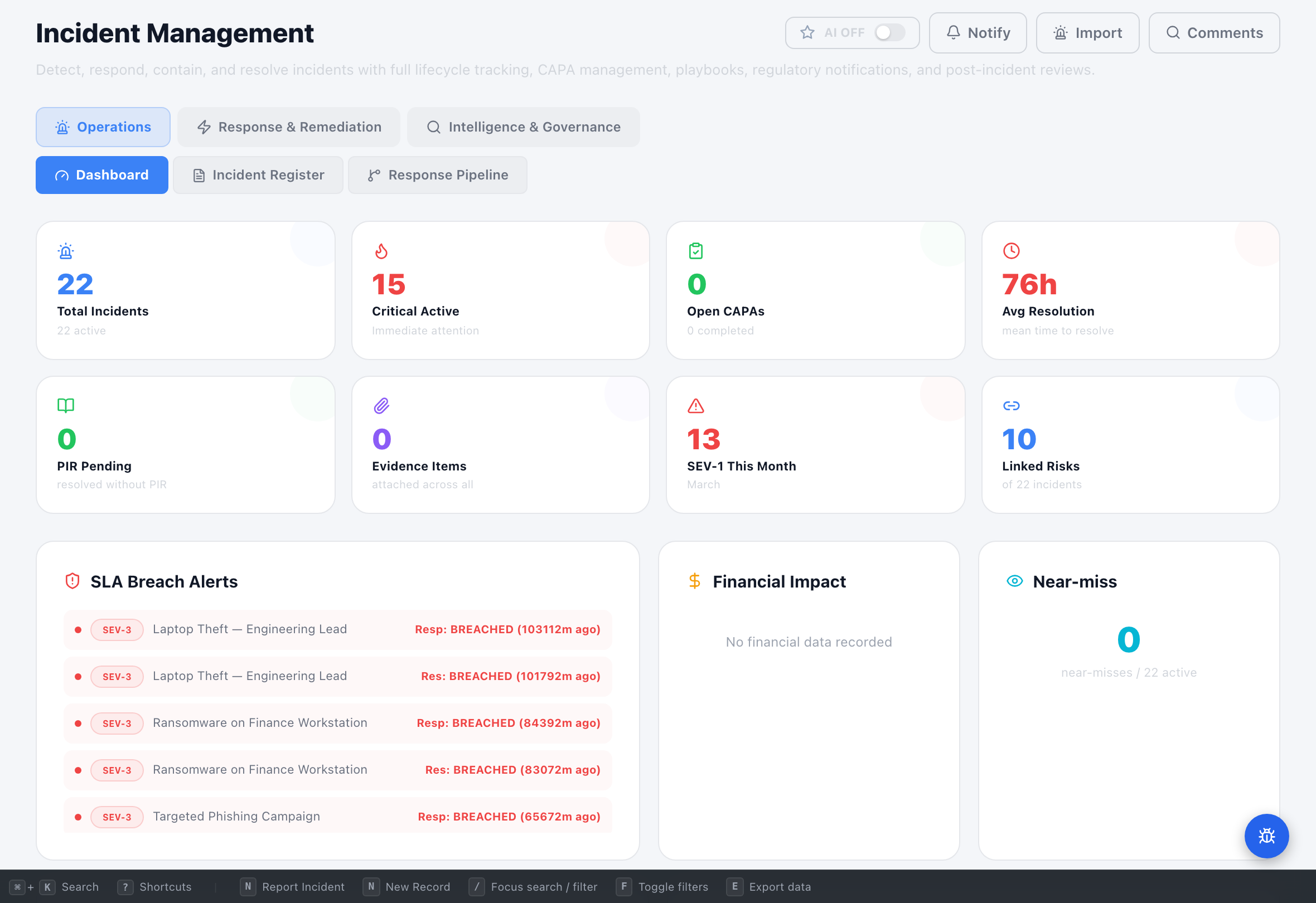
Complete incident lifecycle management from initial reporting through post-incident review. Classify incidents by severity, execute structured response workflows, perform root cause analysis, link incidents to risks and controls, track timelines with full activity logs, and generate compliance-ready incident reports.
The problem we solve.
Why teams switch to Compliance Enablers for incident management.
Industry challenges
- Incidents tracked in email threads and chat messages — no structured workflow
- No standardized severity classification — every incident handled ad hoc
- Root cause analysis is an afterthought — same incidents keep recurring
- Regulatory notification deadlines missed because there's no tracking system
- Lessons learned documented but never applied — no connection to risk or controls
How we solve it
- 8-stage incident lifecycle pipeline with 15+ response playbooks and MTTR/MTTD metrics
- Standardized severity classification with automated escalation and SLA tracking
- 3 root cause analysis methods (5-Why, Fishbone, Causal Chain) with MITRE ATT&CK mapping
- Regulatory notification tracking across 15 jurisdictions with countdown timers
- CAPA tracking with effectiveness verification — incidents link directly to risk and control updates
Built for depth,
out of the box.
Every capability is production-ready on day one. No add-ons, no extra subscriptions.
15+ Ready-to-Use Response Playbooks
21+ tabs. 15+ playbooks covering ransomware, data breach, phishing campaign, DDoS, insider threat, malware outbreak, unauthorized access, system outage, credential theft, lateral movement, supply chain compromise, and more. MTTR/MTTD metrics tracking.
12 Incident Type Categories with 50+ Subtypes
Security breach, malware, phishing/social engineering, DoS, insider threat, data leak, system outage, physical security, compliance violation, vendor/third-party, fraud — each with 4-6 subtypes.
3 Root Cause Analysis Methods
5-Why Analysis (iterative drilling), Fishbone/Ishikawa Diagram (6-category analysis), and Causal Factor Chain (event sequence with timeline).
8-Stage Incident Lifecycle Pipeline
New → Triaged → Investigating → Containment → Eradication → Recovery → Resolved → Closed. Each stage with role assignments and estimated duration.
MITRE ATT&CK Mapping & SIEM/EDR Detection Source
14 tactics and 60+ techniques mapped to incidents. Record SIEM/EDR alerts as the detection source (automated incident creation on the roadmap). Classify incidents by attack technique for pattern analysis.
Regulatory Notification Tracking
Track notification deadlines across 15 jurisdictions with countdown timers. CAPA tracking with effectiveness verification.
The shape of the model.
8-Stage Incident Response Pipeline
Why it matters.
Part of a connected whole.
Incident Management shares a unified data model with every other module. Zero silos, by design.
See Incident Management
in action.
Book a 30-minute demo and we'll walk you through incident management tailored to your team, frameworks, and priorities.