AIGovernance
Govern Every AI System You Run — Including Ours
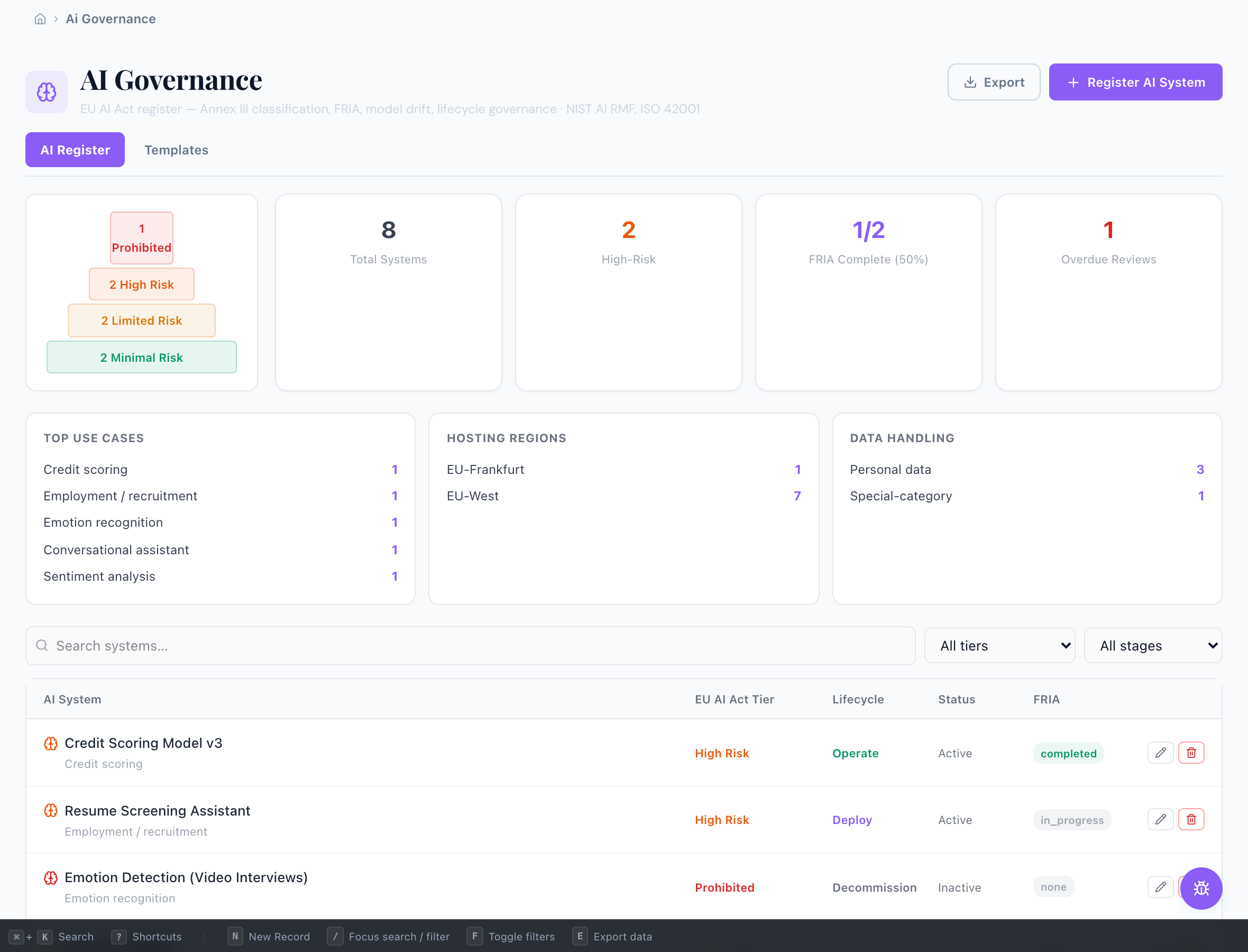
An AI system registry built around the EU AI Act: a one-click classifier scores every system against Article 5 prohibited practices, the Annex III high-risk categories, and Article 50 transparency triggers; you run fundamental-rights impact assessments (Article 27), test for bias with real fairness metrics, validate model cards against Article 11, and classify AI incidents against the Article 73 reporting clock. We hold ourselves to the same standard — Compliance Enablers registers and governs its own Sage AI, built on Anthropic Claude, in this very module: disclosed provider, logged actions, and human approval on AI-generated output. ISO 42001 AIMS controls run on the same module, complementing our ISO 42001 framework guidance.
The problem we solve.
Why teams switch to Compliance Enablers for ai governance.
Industry challenges
- Nobody knows how many AI systems are actually in use across the organization
- EU AI Act obligations understood in legal memos but not operationalized per system
- No model cards — when a customer or regulator asks how a model works, the answer is a scramble
- Bias testing happens ad hoc, if at all, with no record of what passed or what surfaced issues
How we solve it
- Central AI system registry with a one-click Article 5 / Annex III / Article 50 classifier on every entry
- FRIA workflow (Article 27) with build, validate, and gap-check steps and draft-to-completed status tracking
- Real bias and fairness metrics — disparate impact, demographic parity, equal opportunity — plus Article 11 model-card validation
- Article 73 incident classification, promote-to-risk, and ISO 42001 AIMS controls in the same workspace
Built for depth,
out of the box.
Every capability is production-ready on day one. No add-ons, no extra subscriptions.
AI System Registry with One-Click EU AI Act Classifier
Register every AI system, then classify it in one click: the engine reads Article 5 prohibited practices, the eight Annex III high-risk categories, and Article 50 transparency triggers, and returns the tier — Unacceptable, High, Limited, or Minimal — with the article-by-article obligation set.
Fundamental Rights Impact Assessment (Article 27)
Build a FRIA template from the system, validate the submission, and gap-check it — with FRIA status tracked from draft to completed, so the Article 27 assessment high-risk systems require is a managed workflow, not a memo.
Bias & Fairness Metrics
Compute real fairness metrics per system — disparate impact against the four-fifths rule, demographic parity, and equal-opportunity difference — with a fair-or-biased verdict, not just a “tested / not tested” flag.
Article 11 Model-Card Validation
Document purpose, training data, bias metrics, and deployment per system, then validate the model card against EU AI Act Article 11 technical-documentation expectations — a completeness score with the missing and empty sections named.
AI Incident Classification (Article 73)
Classify an AI incident by severity and get the Article 73 reporting window back — the 15-day serious-incident clock — plus the parties to notify, so post-market reporting duties are answered from the record instead of rediscovered under pressure.
We Govern Our Own AI Here
Sage AI — our assistant built on Anthropic Claude — is registered in this module with a disclosed provider, logged actions, and human approval over its output. The governance we sell is the governance we practice.
ISO 42001 AIMS Controls
ISO/IEC 42001 AI management system controls and scope validation run on the same module, building on the EU AI Act registry foundation so one workspace evidences both the law and the standard. See our ISO 42001 framework guide for the standard itself.
Why it matters.
Part of a connected whole.
AI Governance shares a unified data model with every other module. Zero silos, by design.
See AI Governance
in action.
Book a 30-minute demo and we'll walk you through ai governance tailored to your team, frameworks, and priorities.